Wednesday, March 30, 2016

Early Season Botany

Things are finally really starting to happen: I had my first butterflies of the season recently, new birds are coming back every day, and today I had my first blooming wildflowers of the season. Coltsfoot (Tussilago farfara) is a non-native species, but a very welcome one in my opinion, as it is one of the very first wildflowers to come up in spring. The flower emerges before the leaves.


Trout lilies (Erythronium sp.) are one of our most characteristic spring forest flowers. Although for the most part I haven't found any new leaves coming up, there is one exception. This firepit has been in use almost continuously for the last few weeks, and the heat has induced an early emergence for a number of trout lily leaves.


Of course, most of our trees also produce flowers, and several maples are very early bloomers. These flowers belong to Silver Maple (Acer saccharinum).


A number of our ferns are evergreen, and on a recent hike along the Niagara Escarpment I found a couple characteristic species of this formation.

Maidenhair Spleenwort (Asplenium trichomanes)

Walking Fern (Asplenium rhizophyllum)

Despite their radically different appearance, these two ferns are in the same genus. According to the Peterson Guide to ferns of the Northeast, these species do not hybridise, but each will hybridise with a third species, Ebony Spleenwort (Asplenium platyneuron).

Not long until our forests and fields turn green again!

Thursday, March 17, 2016

First Herps of the Year

With a very warm winter and early spring, the first reptiles and amphibians have emerged somewhat earlier than usual. So far this year, I've seen or heard six species, including Spring Peeper, Red-backed Salamander and the four species pictured below.

Leopard Frogs are not quite ready to really begin their breeding season, but have still emerged in large numbers. I thought this individual had a really interesting pattern of spots on the back.


Most of the amphibians that spend the summer on land begin their breeding very early in the spring, and I encountered large numbers of Wood Frogs at vernal pools this week. They can get a little bit too excited sometimes, and a couple of times I noticed 3, 4 or more males all clinging tightly to a single female.


Wood Frog Eggs


Western Chorus Frogs were also singing away, and using my best Great Blue Heron impression I was eventually able to sneak close enough for good views. Normally they stop singing as soon as you get anywhere close.


My first and so far only reptile of the year was this Northern Map Turtle in Rondeau Bay.


Hopefully more to come as spring progresses!

Thursday, February 18, 2016

Ontario Nature Groups

There are lots of great forums, Facebook pages, email lists and similar things online about various aspects of nature in Ontario, but finding out about them is not always easy. To help with this, I have compiled a list of all the groups I know of here. You can also visit it from the link at the top of the page. Check it out, and please let me know if you know of any additions, as I'm sure I've missed plenty!


Wednesday, February 17, 2016

More Midwinter Birding

With the exception of one frigid weekend, winter continues to be abnormally warm in Southern Ontario. In late January/early February a very warm spell brought some new migrants into Ontario, particularly waterfowl.

The big story has been geese - Ross's, Lesser Snow and Greater White-fronted Geese, all of which normally migrate well to our west, have turned up in close to unprecedented numbers. Of course, with the way most goose populations have been exploding, unprecedented numbers are not unprecedented! Still, they are very nice to see for Southern Ontarians who often pick through thousands of Canada Geese without finding another species.

I spent a bunch of time in the Rondeau area. On the way down I stopped at the Ridgetown Sewage Lagoons and was very happy to come across a flock of 12 Greater White-fronted Geese.

Although they have increased dramatically, "specklebellies" are still an exciting find.


The largest group of Snow Geese seen in Ontario recently was the flock of over 200 at Rondeau Bay. This flock had been seen repeatedly for a few days, but I was the first one to pick several Ross's Geese (a lifer for me!) out of the flock. I think this has less to do with birding skill, and more to do with the fact that I was (I believe) the first person to get extended close views of the main group! They still weren't close enough for good photos, but I was able to get good scope views of at least two of the much smaller and stubbier-billed Ross's Geese.

A small portion of the flock. There were also Canada Geese, Tundra Swans, Mallard, American Black Ducks, American Wigeon, Gadwall and Northern Pintail using this field - pretty good for February! 


These rare geese were not my best waterfowl in the area. While looking through the large numbers of Tundra Swans hanging out around the edges of Rondeau, I noticed a swan with a large square yellow patch on the upper bill - a Bewick's Swan. This is the Old World subspecies of Tundra Swan, and is rarely seen in North America. Certainly one of the rarest birds I've found. Too far for photos unfortunately.

There was some confusion initially as it turned out that Blake Mann et al. had seen a leucistic swan there that very morning which also showed a large yellow patch on the bill. I started to doubt myself, but it turned out that there were indeed two birds present. I did eventually see that bird as well a couple of days later, again too far for photos (Blake has photos of this bird on his blog, I don't know if anyone got photos of the Bewick's).

I'm not sure what to make of this leucistic swan - it seems too unlikely for a rare vagrant to also be a rare leucistic bird, but that certainly seems to be the case! I wonder if a leucistic Tundra Swan from the North American population could also show this yellow patch. We may never know!

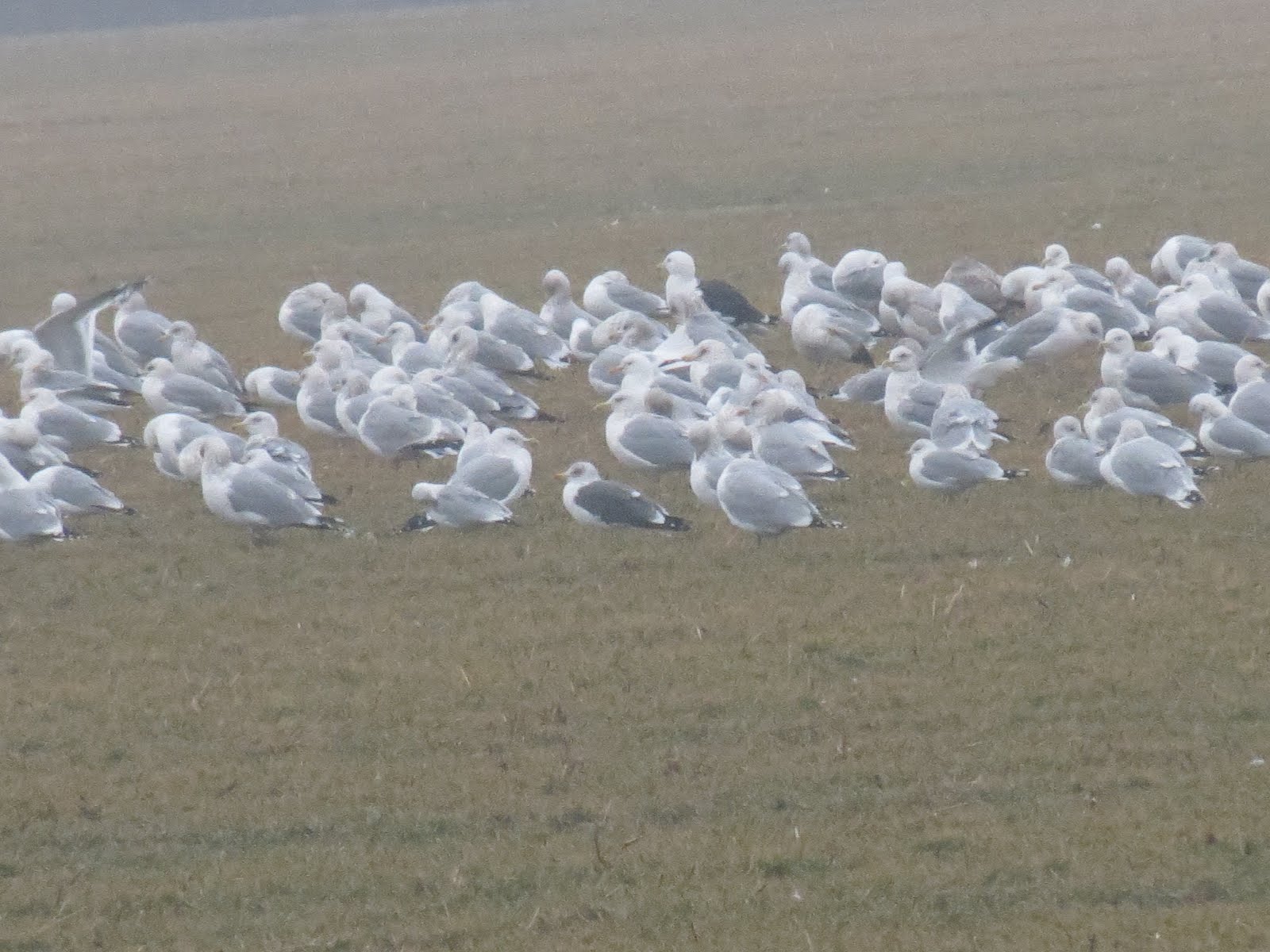
I did see some birds other than waterfowl of course! I have spent very little time in the Rondeau area outside of springtime, so wanted to get some winter birds for my local list. Some time spent around the dump netted me lots of gulls resting in fields, including my first Lesser Black-backed and Glaucous for the area. This is an adult Lesser Black-backed, note the small, slim shape and dark grey (not black) back.


One attraction of Southwestern Ontario not present farther north is the large numbers of blackbirds wintering in farmland. I came across several flocks, including this one which included Red-winged Blackbirds, Brown-headed Cowbirds, Common Grackles (not in this photo), European Starlings and House Sparrows. All you need is a crow and you get a list of the grain farmer's most hated birds!


Back to Mississauga, blackbirds are quite unusual in winter time. I did come across this male Red-winged Blackbird, which may have been a very early migrant in the warm weather. 


Winter's biggest redeeming feature is the owls, so I'll finish up with a couple species I've come across recently.

First, a Barred Owl that was sitting beside the parking lot of a local conservation area:


And a well-hidden Long-eared Owl in the same small patch of conifers I see one in every winter:

Sunday, January 24, 2016

Owls and Other Birds


I've done lots of birding in the last few months, and although I haven't had any serious rarities, I've had lots of interesting sightings. Owls are always an attraction in winter so I'll start with a few different species.

When I spotted a small owl low down in a tiny cedar, I was surprised to find this Eastern Screech Owl rather than a Northern Saw-whet Owl which often roosts in this fashion. Not a bird I generally get close views of in the day, so definitely a highlight.


I've also discovered this screech owl roost hole on my patch - it's nice to be able to see one whenever I want!


Eastern Screech Owl is one of two common resident owls in this area, the other being Great Horned. One disgusting December day with strong winds and freezing rain I came upon this very unhappy individual. Based on the small size this is probably a male.


I've "only" had two Snowy Owls this winter, but both have provided great looks. The first was roosting on the roof of a house near Lake Ontario.


When waterfowl hunting occurs at Rondeau in the fall, large numbers of Canada Geese spend the day resting on the beach where they are safe. I checked these flocks thoroughly several times, and came across one Cackling Goose as well as these two Snow Geese: an adult blue morph and young white morph.


Eared Grebe was another highlight from Rondeau in late fall, with at least two individuals spending time along the beach. Eared Grebe is a western species that only occurs sporadically in Southern Ontario.


One last highlight from Rondeau was this young Red-headed Woodpecker in early December. Red-headeds only winter in very small numbers in Ontario, and this is by far the latest I've seen.


Any shorebird is a nice find in winter, so I was happy to spot this Killdeer along the shores of Lake Erie in Haldimand County in late December.


American Pipit is an honorary shorebird, feeding on invertebrates along shores and in wet areas. This one in Mississauga recently is one of very few January records for our area. Presumably it was pushed off of a farm field somewhere with the first major snowfall of the winter.


This Northern Shoveler was at the same tiny park. Although it is a common wintering species in Hamilton, shovelers are very rare in Mississauga in winter.


A very nice surprise on my first visit to my patch of the new year was this Common Yellowthroat, seemingly very healthy and active despite its missing tail. A few winter yellowthroats are found each year in Ontario, mostly in marshy areas. Oddly, both winter records for my patch have been in dry weedy areas.


For some reason, leucism seems to be more regular in robins than most other species of birds. This is maybe the tenth one I've seen.


Winter may have some good birds, but I still can't wait for spring! The first Horned Larks, gulls and waterfowl will already be starting to move north on warm days, Great Horned Owls will be starting to nest and male Striped Skunks may even be starting to look for mates.

Monday, January 11, 2016

Midwestern Megararity

On the evening of January 1st I was in the Algonquin Park Visitor Centre prior to the annual Christmas Bird Count. I noticed on Facebook that an Ivory Gull had been seen in Duluth, Minnesota that day, and mentioned it to Lev Frid. A plan quickly developed, and early in the morning on January 8th our intrepid band of birders (Lev Frid, Amanda Guercio, Justin Peter and I) pulled out the GTA and headed west.

Our first day was mostly driving, but we stopped in Michigan's Upper Peninsula to look for Sharp-tailed Grouse. No luck, but this Rough-legged Hawk was nice. I also noticed an Eastern Fox Squirrel on the side of the road as we drove through the Lower Peninsula, and a massive raft of Redhead in the Straits of Mackinac between Lake Michigan and Huron.


After spending the night in Duluth, we made the short drive to Canal Park, set out an offering of Walmart salmon, and were rewarded almost right away.


Ivory Gull is a declining high-arctic breeder that very rarely moves south. I've dreamed of seeing this legendary bird for a long time!

After enjoying the Ivory Gull and the other gulls present, including Thayer's, Glaucous and a locally rare Great Black-backed, we made the short drive over to Superior, Wisconsin where two Gyrfalcons are hunting pigeons at the grain elevators. We were treated to quite a show by this immature brown morph (including a nearly-successful pursuit of a pigeon), and also saw the adult gray morph that is present. Another legendary species, and one that I'd also never seen before.


After this fantastic morning, we headed up to the famous Sax-Zim Bog, home of a nice variety of northern and western species. My goals here included Great Gray Owl, Sharp-tailed Grouse, Black-billed Magpie and Pine Grosbeak. There are also Moose, Gray Wolf, Marten and Fisher here.

Despite trying very hard for both, we couldn't find a Great Gray Owl or Sharp-tailed Grouse, but still saw lots including my lifer Black-billed Magpies. Many Pine Grosbeaks were at the visitor centre feeders.


Another feeder held many Evening Grosbeaks. The two magpies were here as well but they flew away immediately when we pulled up, so we couldn't get photos.


We tried unsuccesfully for Great Gray Owls until dark, and then drove south through Wisconsin to put us near a few interesting birds in the morning. We actually stayed in Minnesota on the other side of the Mississippi River, amid surprisingly spectacular scenery.

A vagrant Lewis's Woodpecker has been visiting a feeder near Galesville, Wisconsin, and we quickly saw it when we got there.


A nice male Oregon Junco was visiting the same feeder.


Our last stop of the trip was a region noted for it's wintering eagles, and we soon found this nice Golden as well as a number of Bald Eagles.


And with that we started the long drive around the south end of Lake Michigan, and eventually pulled into Mississauga around 2 am. An amazing trip, if a bit too short for my liking!

Thursday, December 24, 2015

More Algonquin Orchids

The long overdue sequel to this post.

I posted this picture in my previous post about parasitic plants, but I'll include it here too. This is a Spotted Coralroot (Corallorhiza maculata), a common orchid of Algonquin forests.


The rattlesnake plantains (Goodyera) are a small group of orchids found in coniferous forests, with two common species in Algonquin.

This is Dwarf Rattlesnake Plantain (G. repens). I showed the leaves in my last post, but only later got photos of the flowers.


This aberrant Dwarf Rattlesnake Plantain is missing the pale cross-hatching that most individuals have on their leaves. 


Tesselated Rattlesnake Plantain (G. tesselata) is similar but larger.


I found this rattlesnake plantain in somewhat atypical habitat: a roadside in pure deciduous forest. I think it is a Tesselated but it may be a hybrid with Dwarf.


One of my favourite orchids of those I have encountered so far is Ragged Fringed Orchid (Platanthera lacera). Not particularly common in Algonquin, a population of this species has persisted in the same roadside ditch for decades.


The next two species were actually seen outside of Algonquin Park, but both can be found in similar habitat (sandy riverbanks) in the park. Small Purple-fringed Orchid (Platanthera psycodes) is a gorgeous and obvious flower.


Tubercled Orchid (Platanthera flava) is much harder to find and very unassuming!


Club-spur Orchid (Platanthera clavellata) is a common species of various boggy areas including roadside ditches. I found this plant without flowers and checked on it nearly every day waiting for all the flowers to open.


Rose Pogonia (Pogonia ophioglossoides) was somewhat more surprising to encounter in a ditch, although it is reasonably common in bogs.


Green Adder's Mouth (Malaxis unifolia) is a tiny and subtly beautiful orchid under 10 cm tall.


Platanthera orbiculata has been split into two species: P. orbiculata and P. macrophylla. Why the rules of binomial nomenclature insist that one of the species retains the name of the lumped species is beyond me, as it causes huge amounts of confusion. It is usually not a problem in groups like birds or dragonflies that have standardised common names (at least in North America), but for some reason botanists have never done so for plants. As a result, the three orchid books and one comprehensive flora I own call P. orbiculata sensu stricto (i.e. the narrow, split definition of this name) Large Round-leaved Orchid, Pad-leaved Orchis, Round-leaved Orchid, and Round Leaf Orchid, while P. macrophylla  is called Greater Round-leaved Orchid, Goldie's Pad-leaved Orchis, Large Round Leaved Orchid, Large Round-leaved Orchid, and, coming out of left field, Dinner Plate Orchid. Note that the same name is used for both species, and that one book manages to use two names for the same species! I better not buy any more books to avoid any further confusion.

Anyways, the species themselves are not easy to separate, and I have found many conflicting reports on how to distinguish them. Nevertheless, I believe that the first two photos refer to P. macrophylla  i.e. the larger one of the two, with the second two referring to P. orbiculata sensu stricto i.e. the smaller one of the two. I'm certainly not confident though!


Broad-leaved Helleborine is Ontario's only widespread non-native orchid, found in a variety of habitats, mostly ones with at least some disturbance.


Most orchid flowers undergo a rotation as they grow, ending up inverted 180 degrees. This photo gives some indication of what cues control this. This Helleborine had a very heavy spike of flowers, and ended up bending over under the weight. The flowers on top still ended up facing up, indicating that something like gravity or light controls the rotation, and it is not just rotating 180 degrees from the orientation of the stem.


The ladies' tresses (Spiranthes) are a large group of orchids found mostly in open areas, generally thriving shortly after clearing. Slender Ladies' Tresses (S. lacera) thrives in very dry barren areas in Algonquin Park.


Nodding Ladies' Tresses (S. cernua) is a very common species that prefers somewhat damper habitats, often being found in ditches.


And that's it! I have posted photos on this blog of every orchid I found in Ontario this year that I was able to identify. Hopefully more to come next year! I say every one I was able to identify, as there were several I wasn't. I'll leave off with this one from Northwestern Ontario. It is one of Platanthera aquilonis, dilatata or huronensis, but is probably not identifiable after the flowers are gone.