Tuesday, July 29, 2014

Somatochlora Medley

The genus Somatochlora contains numerous species of medium to large dragonflies, including 16 known from Ontario. Even in appropriate habitat, these dragonflies rarely or never seem to be common, perhaps as they only visit breeding sites briefly and spend most of their time feeding in the canopy or in small forest clearings. I have encountered 6 species of Somatochlora this summer in Algonquin Park.

Clamp-tipped Emerald is a southern species near the northern limit of its range here in Algonquin Park, and is found in rocky forest streams. I caught these two patrolling a logging road near their breeding stream.

Female

Male with his extraordinary claspers

Kennedy's Emerald is found in stagnant flooded sedge meadows.

Male Kennedy's Emerald

Lake Emeralds breed in deep nutrient-poor lakes, but disperse widely to forage.

Not the best photo, but this female is one of the few individuals of this fast-flying species I've actually managed to catch this summer.

Brush-tipped Emeralds use flooded sedge meadows like Kennedy's but usually seem to be found in areas with some flowing water. This small species is easier to catch than most Somatochlora.

This female was not hard to catch, as she was catching the deer flies buzzing around my head!

Male - you can see where the name Brush-tipped originates by looking at the claspers on the tip of the abdomen.

Occelated Emerald seem to be restricted, at least locally, to fairly rapid streams with steep dirt banks and little to no floating or emergent vegetation. They have been described in the literature as being found in shady forest streams but I have often found them along streams in sunny beaver meadows.

Male

Williamson's Emerald seems to be much less specialised than the other members of their genus, but still are very uncommon.

Male

Saturday, July 19, 2014

A few butterflies

I've been spending a bit more time focusing on butterflies instead of odes recently, and have had some success. Here's a few recent shots:

Two-spotted Skippers (left) are uncommon in Algonquin, but can be reasonable easy to find in sedge meadows. Long Dash Skippers (right) are very abundant in wet areas, although numbers are starting to decline in the last week.

Accidentally introduced to London, Ontario in the early 1900s, European Skipper is now extraordinarily abundant in the province.

Delaware Skipper has always been considered very rare in Algonquin Park, but a recent visit to an area near the southeast corner of the park revealed them to be reasonably common. They may have been overlooked, or like other southern species they may be increasing at our latitude.

After being very rare last year, it is somewhat reassuring that Monarchs seem once again to be reasonably common in the park this year.

I have been seeing Banded Hairstreaks quite regularly around the Visitor Centre, but there is one less now that this crab spider has had it's way! Note the tiny male riding around on the larger female.

Thursday, July 10, 2014

Garter Snake Predation of a Black-throated Blue Warbler Nest

On June 22, 2014, I was walking down a dirt road in Algonquin Park when I noticed the agitated chips of Black-throated Blue Warblers just off the trail. I walked up and the female came right out towards me, while the male continued chipping farther back in the bush.


I knew there must be a nest nearby, and sure enough I quickly found one low in a young Hemlock. I also quickly noticed though that a large Eastern Garter Snake was draped over the branches just above the nest!


After watching for a while with nothing happening except the continued agitated chipping of the adult warblers, I moved closer and caught the snake. I couldn't feel any lumps of eggs or nestlings in its body, but given the large size of the snake this was not too surprising. The nest was empty:


I have no doubt that the snake had just emptied the nest of the eggs or nestlings. Nest predation by garter snakes is rarely observed, but has been documented several times in the past.

Sunday, June 29, 2014

Late June Moths

I've been spending some time looking at moths recently; here's some recent shots.

Blinded Sphinx

Delicate Cycnia

Northern Pine Sphinx

Oval-based Prominent

Rosy Maple Moth

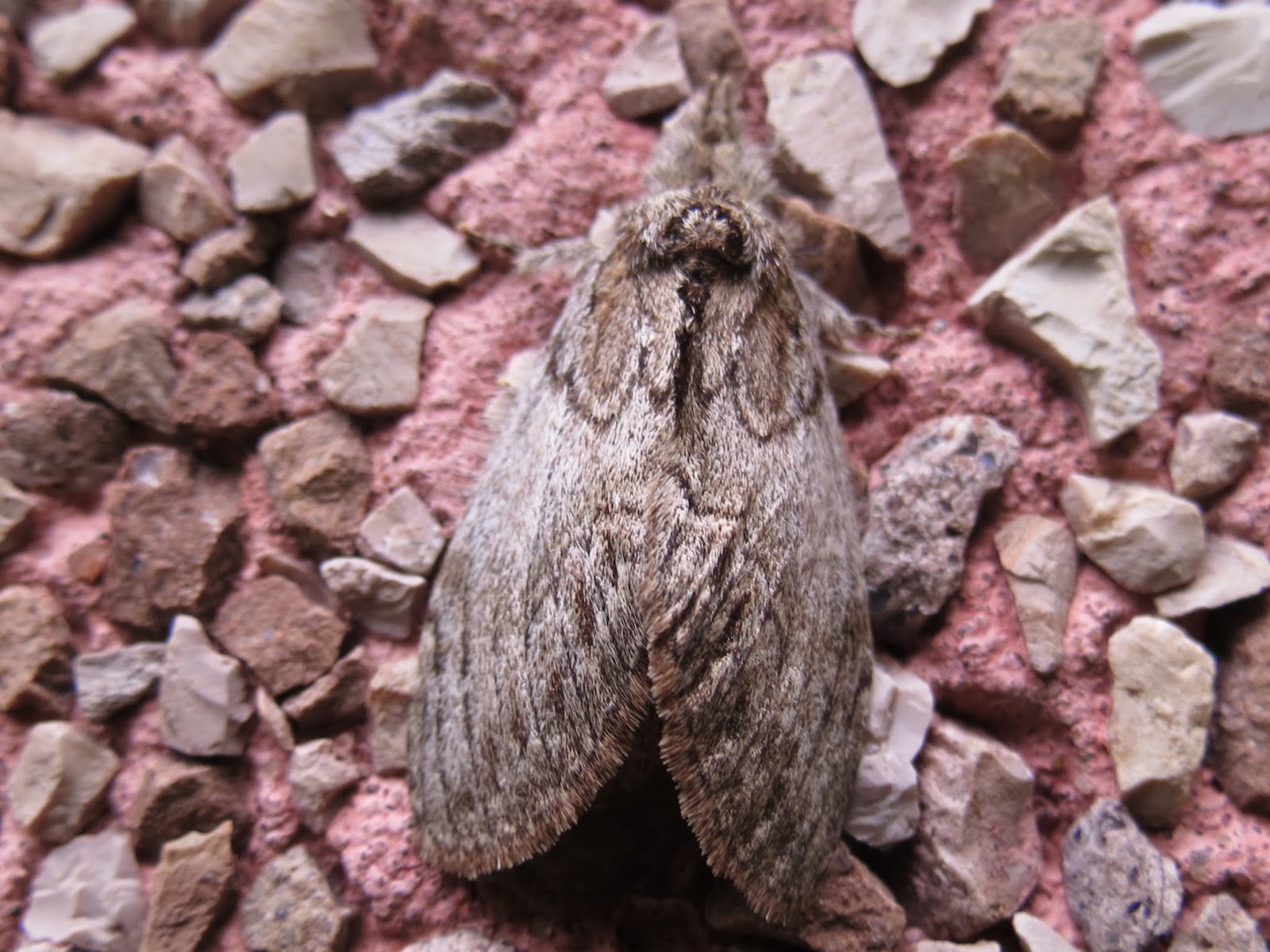
Spotted Tussock Moth

The Laugher

Unicorn Prominent

Virginian Tiger Moth

White-dotted Prominent

Friday, June 20, 2014

Mudpuppy Magic

This week I saw a number of Mudpuppies at Samuel de Champlain Provincial Park. My only previous sighting was one caught in a minnow trap on the Mattawa River just west of this park, so it was great to see this fully aquatic salamander again. This is by far my most exciting recent sighting, but some other cool creatures are pictured below.

A moderately sized Mudpuppy. A hint of the yellow stripes of the larvae is still visible.

Silvery Checkerspot on my lunch break today - only my second ever.

Harlequin Darner - this uniquely marked dragonfly is hard to find. It is interesting in that it seems to be a habitat generalist - found in streams, rivers, bogs, marshes and ponds - but is still fairly rare.

The most common dragonfly right now by a long way is Chalk-fronted Corporal, with large numbers resting in the sun on gravel roads, fallen logs and rocks.

Lured by an easy meal, these Turkey Vultures were among about 50 roosting at the Whitney Dump.

Pink Lady's Slipper is a beautiful orchid commonly found in June.

Friday, June 13, 2014

Boggerflying

It's been quite some time since I posted (computer issues and starting work at Algonquin have held me up), but I wanted to make a quick post about some special butterflies. Earlier this week several of the Algonquin Naturalists headed out in search of bog-inhabitating butterflies, in particular the Jutta Arctic. After some brief flybys, we finally managed to find one of these rarely-seen insects sitting still.


The same bog also held a number of fritillaries. I believe them to be Bog Fritillaries, but it is a difficult identification from above and I would welcome comments. I have never seen this species nor Jutta Arctic before. (edit: I later confirmed these as Bog Fritillaries)

Friday, May 30, 2014

A Cute Kind of Day

Last weekend I did some exploring in the general Barrie area with Peter Mills. For the most part, we had little luck in finding our targets, but two experiences to bookend the day made it worthwhile.

Our first stop was at Wasaga Beach to track down the regularly nesting Piping Plovers, a lifer for me. They were very easy to find as the nests have been covered in wire cages to protect them from large predators, but views were very unsatisfying. Luckily, we soon came upon a rather tame plover foraging outside the area enclosed by protective fences.


Although we only saw 3, at least 6 birds (3 pairs) are nesting here this year. If there was a competition for the cutest bird in Ontario, I think these guys would win.

The rest of the day was fairly quiet but interspersed with nice sightings such as Yellow-throated Vireo, many Black Terns, Common Gallinule, Sora, several Northern Water Snakes, and a few common dragonflies that were firsts for the year.

Later in the evening as we walked along the waterfront in downtown Barrie, we noticed about a dozen people were photographing something in a grassy area next to the train tracks. As we got closer, two fox kits were very apparent as they lounged on the grass outside their den!


Not really what you expect to see in the middle of the city!