Wednesday, November 11, 2015

Portugal and Spain Part 2

The tiny British territory of Gibraltar is mostly heavily urbanised, but the largely undeveloped top of the "rock" still holds some wildlife.

The main attraction here is the Barbary Macaques. These monkeys were introduced, probably by the Moors over 1000 years ago. They are not really wild anymore (they're fed fresh fruit daily!), but still neat to see.


They take all wildlife seriously in Gibraltar!


Iberian Wall Lizards were common on exposed rockfaces throughout the trip. Other reptiles seen included Moorish Gecko, various other unidentified lizards, and an undidentified turtle.


Probably the highlight of my trip was a hike at Sierra Crestillina in Casares, Spain, where large numbers of Griffon Vultures can be found year-round. Unlike our Turkey Vultures, these birds are massive, with wingspans of up to nine feet. A spectacular bird!


The landscape was equally spectacular.


Finches are a more dominant part of the avifauna than in Ontario. European Goldfinch (below) were the most common, but we saw six other species, as well as two species of introduced African estrilid finches.


Another major highlight came on a hike from the village of Frigiliana, where we came across a number of Spanish Ibex, a species of goat.


They certainly like rugged terrain!


Ibex surveying its domain.


We saw a few other mammals, including European Rabbit, Egyptian Mongoose, Red Squirrel (not the same as our Red Squirrel!), various bats, and a dolphin species (probably Common Dolphin).

We saw a variety of crows, jays and magpies, but most were quite timid. Jackdaws are a small crow relative with an odd grey nape.


The only shrike found over the winter is Southern Grey Shrike, which has an oddly pink-tinged breast. We only saw two of these over the trip.


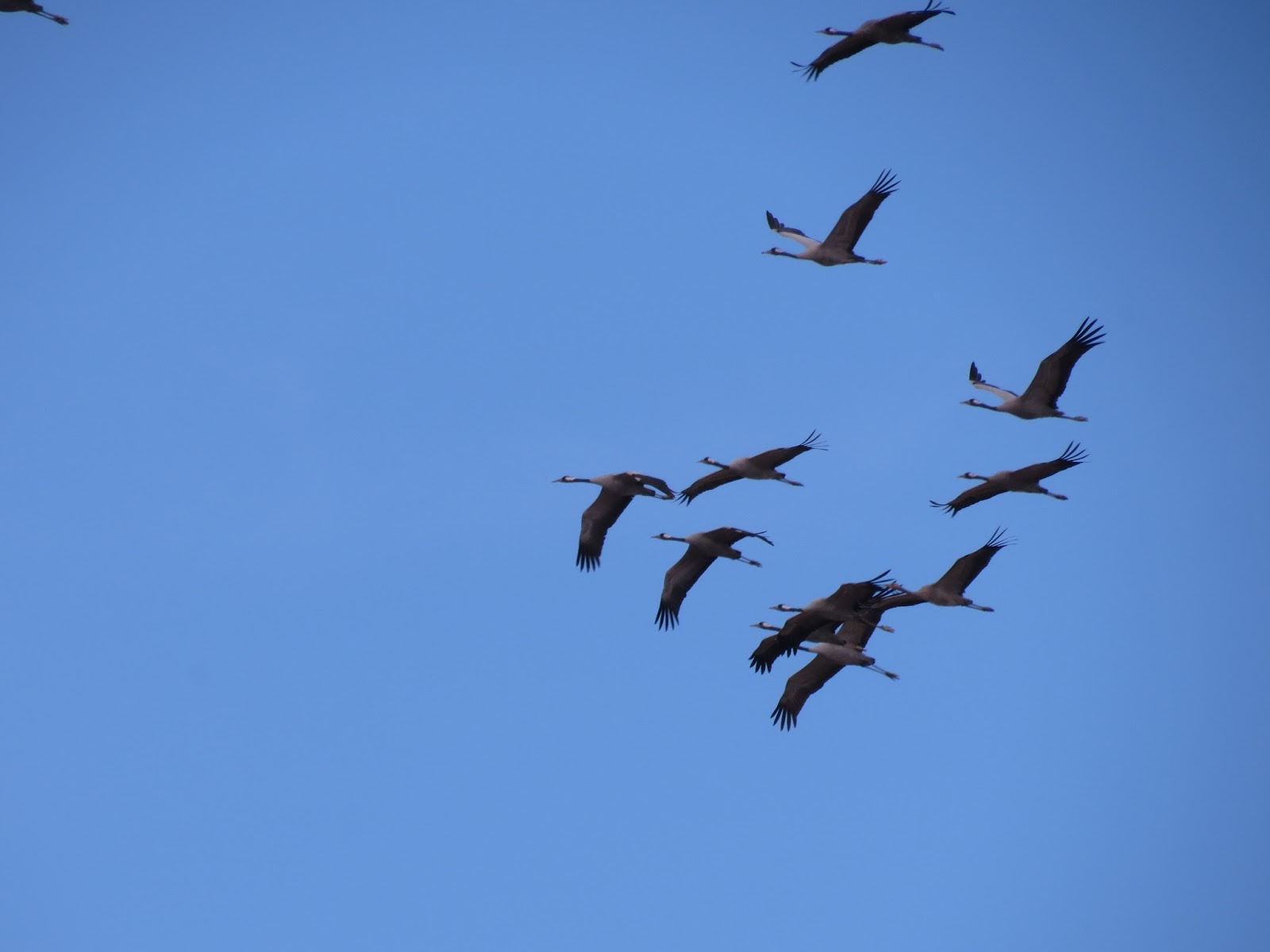
Another big highlight was seeing two small flocks of Common Cranes totaling about 20. Although we only got distant views of them on the ground, they obligingly flew almost directly overhead!


Sunday, November 8, 2015

Portugal and Spain Part 1

Pilar and I just got back from an amazing two weeks spent in southern Portugal and Spain. I've got lots to share so will break it up into two or three posts. 

Most of our trip was along the coast. Along the Atlantic in Portugal that usually means spectacular cliffs interspersed with beaches. There are a variety of birds specializing in very rugged areas like this, including Crag Martin, Blue Rock Thrush and Black Redstart.


Northern Gannets could be seen migrating south in large numbers. Other seabirds mixed in with them included Cory's and Balaeric Shearwaters, Great Skuas, jaegers and one Razorbill.


Two species of large gull were common everywhere - the resident Yellow-legged Gulls and overwintering Lesser Black-backed Gulls. This is a Yellow-legged, looking a little bit darker than reality in this photo.


We noticed this dead Rhinoceros Beetle dead in a parking lot. The larvae emerge from rotting wood.


A variety of coastal lagoons had incredible numbers and diversity of waterbirds. Among the gulls and Mallards in this photo can be seen Common Pochard, Common Moorhen, Little Egret and Eurasian Spoonbill.


A wider view of the same wetland (Lagoa dos Salgados). There were at least 23 species of waterbird visible from this single observation point.


Black-winged Stilts were a common site at rich wetlands, one of 20 species of shorebirds seen on the trip. It was interesting to see a mix of familiar species like Black-bellied Plover, Dunlin, Ruddy Turnstone and Sanderling among the more exotic ones.


I could not manage a good photo of these gorgeous Audouin's Gulls. This is one of the rarest gulls in the world.


A wide variety of wheatears can be found in open areas throughout Eurasia and Africa, with Northern Wheatear barely extending into North America. We saw many Northern Wheatears (below) as well as a couple of Black Wheatears.


Visible in the backround of this view over Castro Marim, Portugal are artificial salt collection ponds, a common sight in coastal areas. These habitats attract an excellent variety of wading birds and shorebirds.


Wednesday, November 4, 2015

Algonquin Mammals (and a Bird and a Fish)

Just some random pictures from Algonquin Park.

Star-nosed Mole is a species I really want to see alive. This is maybe the fourth roadkill I've seen. Unlike our other moles, Star-nosed is quite aquatic, and uses its bizarre, appendaged nose to detect prey.


Martens are one of my favourite mammals. This one ran up a tree and watched me until I left, occasionally making quiet grunting noises.


We came across two baby jumping mice (Woodland Jumping Mice I think) on a trail. Unlike our other mice, jumping mice hibernate over the winter.


On an interior canoe trip, Todd expertly caught a couple of spectacular Brook Trout in just a few minutes.


Not long after, we came across my first Sandhill Cranes for Algonquin Park: a pair with one mostly grown young (only the young and 1 adult are visible here). This species has expanded its breeding range to an amazing degree in recent years, and is now found in appropriate habitat throughout Southern Ontario.


I couldn't make a post about Algonquin mammals without including a moose. This cow was actually seen on a return trip in mid-October, and was a very nice surprise on a cool and mostly birdless morning.

Wednesday, October 28, 2015

Lepidoptera

Lepidoptera is the order of insects including moths and butterflies (which are really just a group of day-flying moths). I never really spent any time looking at moths this summer, and it was a terrible year for nearly all species of butterflies for some reason, but I still had a few highlights.

Harris's Checkerspot is a species I rarely see, perhaps due to its early flight season coinciding almost perfectly with the peak of blackflies and mosquitoes! This year, I spent a day biking around Algonquin in mid-June and had close views of a few individuals.


Luna Moth is a large and spectacular species. For comparison, the moth on upper left (some kind of prominent I think) would be one of the larger species present on most nights!


The status of Indian Skipper in Algonquin Park is unclear, but it seems to be regular in small numbers at the old airfield at Mew Lake Campground. This is the best picture I could get of this one before it flew away!


Indian Skipper was my second-rarest butterfly of the year in Algonquin Park. The rarest came less than an hour later, as I noticed this Red-spotted Purple feeding on some scat with many White Admirals. These are different subspecies of the same species, and do intergrade. Looking at the photos now, the amount of white on the underside of the forewing may indicate a hybrid ancestry. Still a very rare sight this far north! There are only about three records of Red-spotted Purple in Algonquin.


The story of Monarchs is a very familiar one, but there are still some interesting facts that I don't think are common knowledge. Although the caterpillars are reasonably good at dealing with the sticky and poisonous milkweed sap, they also do their best to avoid it. In this photo you can see that the caterpillar has cut holes in the veins halfway up the leaf, preventing sap from flowing to where it is feeding.


One of our most spectacular caterpillars is the Brown-hooded Owlet, often seen sitting in plain view at the top of Goldenrod.


American Lady is a common butterfly that, like Monarchs, do not winter in Ontario but must migrate from the south each year. The caterpillars are boldly coloured and decorated with scary-looking spines.

Friday, October 23, 2015

Ferns

I had never really studied ferns until this summer, but they are actually a fascinating group. Also one that is surprisingly (to me) straightforward to identify. There are certainly still some tough identifications though. Hopefully I have everything in this post correct!

I've been using the Peterson guide to Ferns of Northeastern and Central North America. The guide published by the Owen Sound Field Naturalists is apparently also excellent although I've never used it. 

Speaking of the Bruce Peninsula, it is one of the best places to find ferns due to the limestone rock and many cliffs. One specialty is the Northern Holly Fern (Polystichum lonchitis):


Maidenhair Spleenwort (Asplenium trichomanes) is another fern found on the Bruce. Like some other species, it is reasonably common along the Niagara Escarpment but hard to find elsewhere.


Moving up to Algonquin Park, the fern diversity is lower but still interesting. Oak Fern (Gymnocarpium drypoteris) is common in woods, including on shady rockfaces.


I showed the rare (for Ontario) Broad Beech Fern in my recent post about Rondeau. This is Narrow Beech Fern (Phegopteris connectilis), a common species in Algonquin.


The three species of Osmunda are large common ferns found in various wet habitats. This is Cinnamon Fern (O. cinnamomea), found in swamps and other very wet areas, generally with some shade.


The Wood Ferns (Dryopteris) are a large and complex group. While most are found in woods as you would expect, the distinctive  ladder-like Crested Wood Fern (D. cristata) is found in wet areas. The books say that is usually found in swamps, but most I've seen have been in sedgy marshes.


Many species of fern are found in crevices of cliffs and rockfaces. Most require basic rock, but a few do use the acidic and nutrient-poor rock of Algonquin Park, including Rusty Woodsia (Woodsia ilvensis).


The Moonworts, Grape Ferns and Adder's Tongue Ferns form a group quite distinct from the typical ferns. This is a Grape Fern (Botychrium), but I'm not sure which species. There were quite a few of these odd ferns growing in a very dry, sunny area. The sterile and photosynthetic frond is on the right, while the fertile frond is on the left, covered in sporangia which will release miniscule spores.

Monday, October 19, 2015

The Way Home

We eventually got the car repaired and started the drive back to Southern Ontario. The town of Atikokan had one last present for us though, in the form of this juvenile American Golden-plover. This species, which can be hard to find in Southern Ontario, and usually only at distance, is often seen on lawns and parking lots in Northern Ontario due to the lack of habitat.


One great spot we stopped was the ghost town of Jackfish. A large clearing is the main attraction for birds here, but I was equally impressed by the gorgeous, rugged shore.


At times, the north shore of Lake Superior can be incredibly good birding, but we hit it on the wrong days, and were able to find very little despite working hard. We eventually decided to call it in and do a long haul south to spend some time on Manitoulin Island and the Bruce Peninsula.

At Providence Bay on Manitoulin Island the dunes are very interesting botanically. Much of the ground was covered in some variety of scouring rush (Equisetum sp.). These horsetails are named for their high silica content, allowing use as sandpaper or for scouring pots.


Nodding Ladies' Tresses (Spiranthes cernua) grows in the same habitat. This orchid is quite common in a variety of mostly wet habitats across Ontario.


Nearby, a gravelly spit had this very odd keyhole shape, with a small marshy area in the centre. Foraging here were a Rusty Blackird and a Lapland Longspur - an odd combination!


I noticed this Monarch caterpillar on some milkweed along the coast. It seemed perfectly healthy, and is only curled up here because I touched it. For the record, this was taken on October 4. Based on its size it will still not be a butterfly by today, and has presumably perished in the cold. Not sure why a Monarch would lay eggs so late.


Two days before our visit a Eurasian Dotterel, the first record for Eastern North America, was seen at Oliphant on the southern Bruce Peninsula. It was long gone by the time we were there, but large numbers of juveniles White-rumped Sandpipers were a nice consolation. Mike Burrell has written more about the unprecedented invasion of this species recently.


On the way back to Barrie, we made a quick stop at a gravel pit where a Hudsonian Godwit has been hanging out - a lifer for me. No pictures as it was very distant. A nice end to an awesome trip!