Saturday, May 24, 2014

300 (+1) and a Local Laughing

Yesterday I cycled down to Lake Ontario in Mississauga in hopes of seeing shorebirds flying by, particularly Whimbrel which are seen in this area at this time every year. When I arrived, it was immediately apparent that extremely impressive numbers of Gulls and Terns were feeding on dead and dying fish (primarily Alewife I believe) in the mouth of the Credit River. This provided a welcome diversion while waiting for shorebirds, and as I scanned through the flocks I noticed first 2 adult Lesser Black-backed Gulls sitting on the water, followed by a very late immature Glaucous Gull.

Turning my attention to the Ring-billed Gulls resting on the wooden boat docks in the harbour, I quickly hit the jackpot - an immaculate adult Laughing Gull!
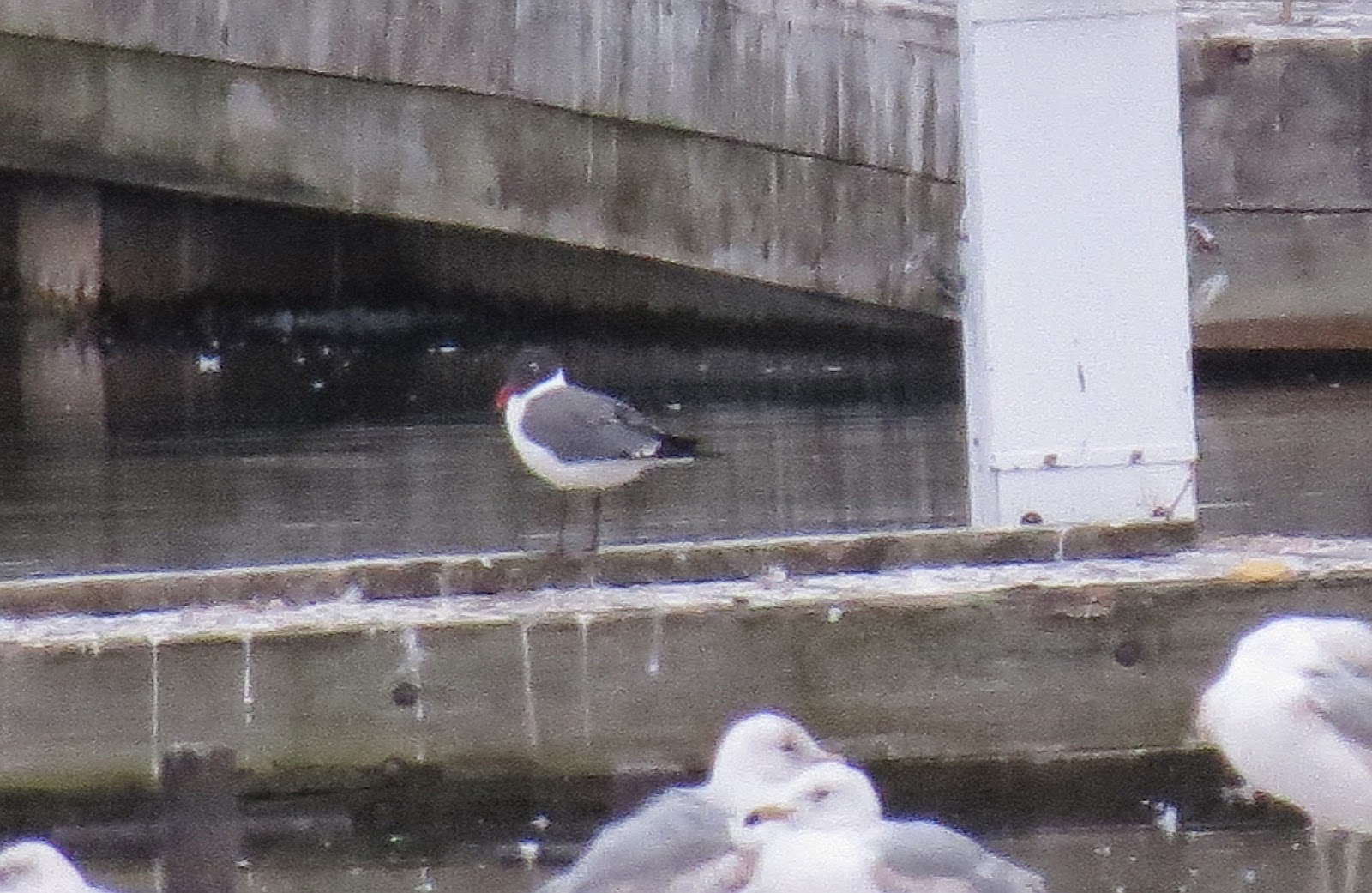
 
Views were much better than this photo suggests!

What is likely the same bird was seen about 3 km to the east a week ago, so I had Laughing Gull on my mind, but still didn't really expect to find it. Laughing Gull is quite a rare bird in Ontario with perhaps 5 sightings a year.

Laughing Gull is my 301st bird species in Ontario. Regular readers may remember that I noted my list was at 296 at the beginning of May, and hoped to hit the "magic 300" this month. Here's how it happened:

297: On May 2nd I easily refound the continuing Eared Grebe at the Blenheim Sewage Lagoons. An overdue lifer! Of note is that this is the only one of the additions that I didn't find for myself.

Eared Grebe

298: Early in the morning on May 6th (and several other days), songbirds were streaming north out of Rondeau by the hundreds to thousands. The cool weather and late leaf-out was likely suppressing insect activity forcing them to move on. I was checking out the movement at the entrance to Marsh Trail, when I put my binoculars on a small flock of chipping sparrows foraging directly on the gravel trail, and immediately noticed an enormous, pale, boldy-marked bird mixed in: a Lark Sparrow! After a few seconds of enjoying the lifer, I ran back to my car (just around the corner) for my camera, but the bird was gone and was never seen again. I had hoped it would forage with the nearby sparrow flocks for the day, but it no doubt headed north with the many birds going by overhead.

299: May 15th - Neotropic Cormorant
300: May 16th - Lark Bunting. My last post told the story of these two incredibly rare birds.

301: May 24th - Laughing Gull

I could have hit 300 a long time ago by chasing rarities and localized birds, but 4 self-found lifers in a row is pretty special! Looking back, the last time I did it was spring 2011, and it is quite likely I will never do it again in Ontario as new birds are rapidly becoming hard to find.

By the way, my shorebirding was also very successful yesterday, with about 110 Whimbrel, 250 Dunlin, 3 Sanderling, 2 Semipalmated Sandpiper and 1 Ruddy Turnstone in total. I'm sure I also missed many birds while looking at gulls!

Lots of these little guys around! Dunlin taken last year

Wednesday, May 21, 2014

A Tale of Two Rarities

I'm back! After a great couple of weeks birding and leading hikes in the Rondeau area, I now have decent internet access again, so expect regular posts to resume. For now, I want to share the story of two very rare birds I stumbled upon last week.

This winter was extremely harsh, and the ice build-up in Rondeau Bay partially destroyed the pier in the park. As it is now inaccessible for people, gulls and terns have been gathering on what is left, and I checked it several times a day while staying at Rondeau.

On May 15th I was walking towards the Marsh Trail parking lot to meet a friend, which took me on a route allowing distant views of the pier. A quick view revealed two cormorants sitting there - piquing my interest as I hadn't seen any on the pier previously. One of the two appeared to be smaller, and while I didn't really think it was anything special, I decided to get closer.

About halfway to the pier I scanned it again, and that cormorant was still looking strikingly small next to the other. This was the point where I started running!

I got to the base of the pier, raised my binoculars and there it was - a Neotropic Cormorant!


Note the short bill, small size and long tail of the Neotropic. There appeared to be some white around the base of the bill, but looks were poor.

After no more than about 30 seconds, the cormorants took off heading south. I called Pilar who was at Marsh Trail and she was also able to see the two distinctly unmatched cormorants going by.

Neotropic Cormorant is the rarest bird I've ever found - although records have been slightly more frequent in recent years, there are still only a handful for Ontario, with this being the first for the Rondeau area. What is presumably the same bird was seen again and photographed at Erieau a couple of days later.

The very next day I had a good day of birding, with the highlight being a gorgeously pink adult Franklin's Gull at Erieau. I was leading a hike on Marsh Trail in the evening with four relatively beginner birders, where we drove well out on the trail to spend much of the evening in the marsh itself.

Shortly after parking and beginning to walk, I noticed several sparrows feeding on the trail ahead of us. Most were obviously White-crowned Sparrows, but one bird was bigger, chunkier and completely unfamiliar, even from views of its back as it hopped around the corner.

We moved up, and I quickly got views of the bird feeding on the trail in the scope. Still, I didn't know what it was! Most reminiscent of Fox Sparrow, my mind leapt to some kind of Old World Bunting. It was only when it flew revealing whitish patches in the wings and a very distinctive white pattern in the tail that I realised what it was - a female Lark Bunting!

It fed for about 5 minutes as I showed it to my hike participants, before it abruptly flew into the bushes on the side of the trail, never to be seen again that evening or the next day. I unfortunately never managed to get a photograph.

Lark Bunting has been recorded about 30 times in Ontario, but is probably now about equal in rarity to Neotropic Cormorant given that species' recent increase in eastern North America.

So there you have it - the two rarest birds I've ever found, and only a little over 24 hours apart! More to come soon.

Thursday, May 1, 2014

Warblers finally

The last week has been cold, wet and windy - not ideal conditions for migration! Things have finally improved a bit and warblers are starting to arrive, with 6 species on my patch this morning.

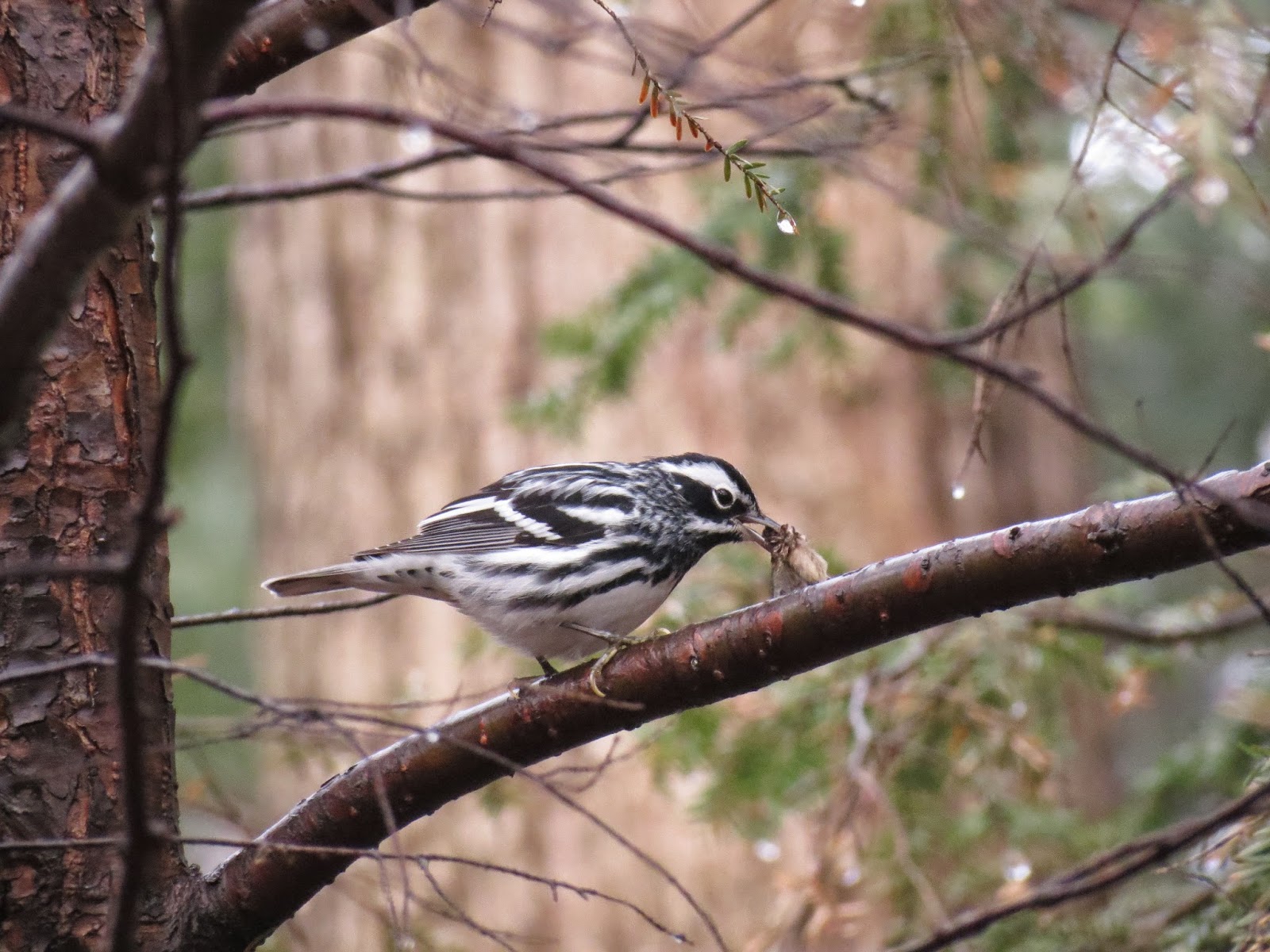
This Black-and-white Warbler found a big moth, and proceeded to process it right in front of me.


Eventually he flew down to the ground to remove the wings and swallow the thick body.

Other warblers I've seen this week include many Yellow-rumped as well as smaller numbers of Pine, Palm, Nashville, Black-throated Green and Northern Waterthrush.

 
Black-throated Green Warbler

Tomorrow I head back to Rondeau for the first two-thirds of May to lead tours for their festival of flight. Right now there are three continuing birds in that part of the province that would be lifers - Eared Grebe, Marbled Godwit and Smith's Longspur. I'll definitely check for the grebe but the other two are a bit more out of the way, and I may just spend more time birding Rondeau and looking for my own birds instead. On the other hand, I am only 4 away from 300 birds all-time in Ontario, and it would be really nice to reach that milestone this month!

Wednesday, April 23, 2014

Hooded Warbler on my Patch!

On my back from a rather uneventful morning walk at my patch in Mississauga this morning, I was shocked to see a bright yellow bird fly across the trail in front of me. I had suspicions about its identity, and sure enough it was a stunning male Hooded Warbler!

This is one of my favourite warblers, as well as a new bird for both my patch and for the year. Hooded Warbler is quite rare this far north, and this is only the second I've seen away from Lake Erie. Luckily, he was sticking to a small area next to the path, so I was able to watch him for as long as I wanted, and indeed several others were able to see him in exactly the same spot later in the afternoon.

Hoodeds have awesome white outer tail feathers.

Although he was skulky, he was unconcerned about my presence, and several times gave excellent close views.

He was spending most of his time in a dense tangle of vines and fallen logs.


I've taken a rest on this stump many times, but never expected to get a photo of a Hooded Warbler in the same spot! Also note the Trout Lily leaves in the background. In the last week I've noticed Trout Lily, Hepatica, Skunk Cabbage, Coltsfoot, Bloodroot and Violets in bloom.

 Coltsfoot

Now, in no particular order, here are a few of the other things I've been seeing recently:

Firefly on the front wall of my house

 We had a few days of snow and freezing temperatures, and insectivorous birds like this Tree Swallow were struggling.

Greater Yellowlegs on ice.

Four-toed Salamander

Spotted Salamander. We missed the main wave of salamander migration but still found a few.

Red-eared Slider - not native to Ontario, but unwanted pets have been released widely.

A few butterflies are around. Expected are Mourning Cloaks and this Eastern Comma.

Somewhat less expected was this Red Admiral today in Mississauga, although quite a few have been seen further along Lake Erie with a few further north since we had strong southwest winds a while back.

We are very close to the first waves of Neotropical migrant birds. On April 26, 2009 I had 9 species of warbler in Mississauga.

Sunday, April 20, 2014

Mimicry by a Purple Finch

In North America, Northern Mockingbird and European Starling are well known as accomplished mimics, but perhaps less well known is that many of our finches regularly mimic other birds.

I took this video of a Purple Finch singing in Guelph. Most of his songs contain an American Robin "chatter" in the middle and a few phrases of Northern Cardinal song near the end, as well some possible Red-winged Blackbird calls, although I'm not totally confident that the latter is really mimicry.


Other North American finches known to mimic are Lesser and Lawrence's Goldfinch, Pine Grosbeak, Cassin's Finch and rarely House Finch. Nathan Pieplow's excellent Earbirding blog has more information.

Friday, April 11, 2014

Spring!

Things are really starting to happen in Southern Ontario just since last week. I've been seeing new birds for the year nearly every day, and the first herps and butterflies are out.

Blackbirds continue to move through the area. Each evening I've been seeing large flocks flying by, and a few days ago I inadvertently discovered where they're going. Below is a fraction of the 1200 birds I estimated being present before they descended to roost in some dense cedar forest.

What's really cool about the whole thing is that several nights later I found myself walking the trails through their roost area well after dark with a few friends while looking for herps (more on that below), and it was obvious that large numbers of blackbirds were present as when we heard them flushing and their wings hitting off branches. It would have been an extremely spooky experience if we didn't know what they were!


There have been lots of new migrants showing up (among others, Northern Flickers, Yellow-bellied Sapsuckers, Savannah, Chipping, Field and Fox Sparrows, Tree Swallows, Eastern Phoebes and Rusty Blackbirds), but the most notable was this Caspian Tern sitting on the ice at the still-frozen Correctional Ponds. Although this is right on time for this species to arrive, it is not a bird I ever would associate with snow and ice!


My first Field Sparrow of the year

I've gone out on the three nights this week with rain and reasonably warm temperatures, but last night was the first time we had much success in finding herps. Things are still slow - in about an hour and half of looking the five of us found less than 15 amphibians between us - but it's great to see them again! There is still quite a lot of snow in the woods which is likely keeping amphibians from migrating to their breeding ponds in large numbers.

Blue-spotted Salamander

Wood Frog

Spring Peeper

The next few days are looking really good, and luckily I have lots of time to enjoy them!

Wednesday, April 2, 2014

Gooselets and more

I haven't been posting much just because I haven't had anything to post. I have been getting out a fair bit, but mostly just for 30 minutes to an hour when I can't stand sitting inside when it's so nice out. Things are definitely happening on the bird front, but I still haven't seen any herps or butterflies this year.

My most exciting recent find has been this group of 4 Cackling Geese (with 3 Canadas in the photo) at the "Correctional Ponds" in Guelph. Note how the bird between the Canadas at back left is fully alert, but is still significantly shorter than the relaxed Canadas. I called the middle bird a Cackling although it was about 20% larger and longer-billed than the other three. Natural variation or hybrid ancestry?


I spent a few minutes hawk-watching at one point to try pick up my first Red-shouldered Hawks of the year, and was quickly successful with two flyovers, as well as a Sharp-shinned Hawk and a few Red-tails and Turkey Vultures. This Red-tail was oblivious to my presence as it hunted from a light pole. Unfortunately, it was looking down on a soccer field with artificial turf, so I can't imagine it was particularly successful!


Other new migrants I've picked up recently include Tundra Swan, Great Blue Heron, Tree Swallow and greatly increased numbers of Killdeer, Turkey Vultures, Song Sparrows and Brown-headed Cowbirds. The first warbler (Pine) should be here within two weeks, and half a dozen new species of sparrows will start showing up any time!